.avif)
1. A brief history of how underwater became strategic
Operating underwater has long been described as an order of magnitude harder than space. Extreme pressure, no GPS or RF signals, biofouling, unpredictable currents, and near total invisibility make the ocean one of Earth’s harshest environments. Yet, like space, it has quietly become foundational to modern life. Here is the short version of that story:
- Mid 19th century: Subsea telegraph cables shrank the world. Today, ~95% of global internet still flows through seabed fiber
- Mid 20th century: The offshore oil and gas boom turned the seabed into an economic frontier, with rigs, pipelines, and platforms
- Cold War era: Nuclear submarines and SOSUS transformed the deep ocean into a theater of great power competition
- Today: Undersea infrastructure is central to the global economy, powering more than $3T in value
- Data: Cables and data centers
- Energy: Offshore wind and fossil
- Food: Fish is the biggest protein source globally
- Hybrid warfare and plausible deniability: Chinese UUV swarms, North Stream, nuclear submarines, narco subs

2. The 21st century barely touched the undersea stack
Despite all its strategic weight, the undersea domain remains mostly analog. The technology stack is brittle. Workflows are slow and costly. Blind spots are huge.
- Data deserts: We still know more about the moon’s surface than the seabed
- Stuck workflows: Inspections depend on subcontracted crewed vessels and tethered ROVs, often $100k per day. Surveys happen once a year, sometimes once every two. Continuous sensing is rare and data is usually siloed
For decades, a handful of incumbents, including Oceaneering, Saab, Saipem, Kongsberg, Teledyne, and others, controlled the subsea industry. Their edge did not come from constant breakthrough innovation. It came from capital intensity: shipyards, foundries, proprietary test facilities, and monopolies over critical sensors.
This structure created a low volume, high margin model. Instead of scaling production or driving costs down, they sold a small number of ultra expensive systems to a captive customer base:
- Oil and gas majors signed recurring inspection and maintenance contracts worth hundreds of millions
- Defence ministries awarded multi year procurement deals for UUV fleets and subsea systems, priced in the millions and bundled with costly service contracts
- Once locked in, these customers subsidized high costs and protected margins
So there was little incentive to move toward affordability, speed, or volume. The underwater tech stack reflected that reality:
- Navigation: No GPS or RF underwater. Reliance on expensive acoustic positioning and low volume, high margin DVLs
- Battery: Pressure tolerant, long endurance packs that can cost hundreds of thousands per unit
- Remote comms: Narrowband acoustics with high latency underwater, and low bandwidth Iridium for offshore to shore
- Edge compute: Historically too weak, expensive and bulky to process sensor data onboard, which limited autonomy
- Fouling: Biofouling steadily reduces reliability and cripples long term deployment
- Industrial monopoly: Only a few players have the infrastructure to produce at all
3. Consequence and status quo
Anyone trying to build UUVs today with top shelf components hits a wall.
- Costs balloon to $2 to $3M per unit
- Supply chains run through slow, inflexible contractors
- Lead times stretch into years
As the industry calcified into an oligopoly, maritime hardware looked non investable to VCs.
- Hardware was locked behind defence monopolies
- Economics were stuck in a low volume, high margin equilibrium
- There was no path to scale, no way to compete, and no venture sized returns
In short, the gates to a trillion dollar frontier were closed. Nobody funded new entrants to try. That was the state of things, until now.
4. The break in the weather: autonomy, connectivity, and new tools
The deadlock that kept the ocean frozen for decades is finally breaking as a convergence of technologies has shifted the balance. For the first time, small entrants can make a dent.
- Starlink: High throughput, low latency entrants makes remote piloting and supervision of USVs possible and returns high resolution data. This is a step up from older systems like Iridium
- Edge compute: Nvidia GPUs and modern processors bring real autonomy underwater. UUVs can process sonar, camera, and navigation data onboard in real time
- AI perception: Models turn noisy, low cost sensor inputs into useful signals and reduce reliance on ultra expensive sensors
- Rapid prototyping and 3D printing: Cut capex to the bone. Teams can design, print, and test new platforms in weeks, not years
- New antifouling materials: Silicone coatings and marine plastics extend the life of resident systems
- Inductive charging: Scaled in adjacent industries. It removes the wet connector problem and enables long duration residency
Together, these advances flip the script.
The old stack was defined by bulkyness, scarcity, and high unit cost. The new stack is defined by autonomy, persistence, and affordability.
For the first time, startups with robotics, autonomy, or space tech DNA can enter the subsea arena. A convergence of autonomy, AI, and new tools makes it possible to:
- Build systems at 10x lower bill of materials
- Use AI to transform cheap hardware into smart hardware
- Iterate in months instead of decades while incumbents remain trapped in slow and high cost cycles
This unlocks a new class of underwater systems:
- Attritable UUVs: Not million dollar precious assets. Fleets of $10 to $20k platforms that you can deploy in swarms
- Mass deployment: Robots cheap enough to risk in harsh or high value environments
- The volume flywheel: As swarms proliferate, they create demand for monitoring, coordination, counter UUV systems, and data at new scale.
This is the inflection point. The subsea world is entering its cubesat moment. Just as small satellites transformed space from a closed, geosat and government led market into a vibrant commercial ecosystem, low cost resident UUVs are set to do the same for the ocean. Bubble exists to seize that moment and define the new standard.
5. The open window of opportunity: persistence redefined
One of the biggest distortions in the subsea market is how people define persistence.
Incumbents built resident systems for the deep sea. Think seabed docking stations engineered to survive at +3,000 m deep, sold for millions, justified only next to billion dollar oil and gas rigs. In that world, persistence meant a few ultra expensive robots living permanently beside equally massive assets.
But the vast majority of subsea assets sit in shallow waters under 200 m. These are offshore wind farms, subsea cables, aquaculture sites, desalination plants, and ports. For decades, operators in shallow water did not adopt resident systems because persistence was too expensive to justify.
That calculus changes when persistence becomes cheap, autonomous, and robust.
- Reduced accessibility costs: No more $50k per day vessels
- Reduced human risk: No more divers in dangerous waters
- Automated operations: Inspections weekly, not yearly. Small issues get caught before they cascade
- Asset uptime: More frequent monitoring means fewer surprises, lower maintenance costs, and longer useful life
Instead of rare, precious, seabed docked robots, persistence can be commoditized. Fleets of light, low cost resident UUVs can monitor continuously at a fraction of today’s cost.
- Opportunity: Commoditize persistence in shallow water.
- Impact: Cut monitoring costs by up to 1000x per km²
- Analogy: Subsea robotics today is still in its geosat era. The real inflection comes when shallow water persistence becomes as cheap and scalable as cubesats in space
This is Bubble’s focus. Flip persistence from a niche, expensive deep sea tool into the foundation of a mass deployable ecosystem. Define the new standard for how the ocean is explored and operated.
6. The last chokepoints, and the road ahead
Even with real breakthroughs, critical bottlenecks remain. These are the pieces that still hold the industry back. They are also the ones Bubble is most focused on solving.
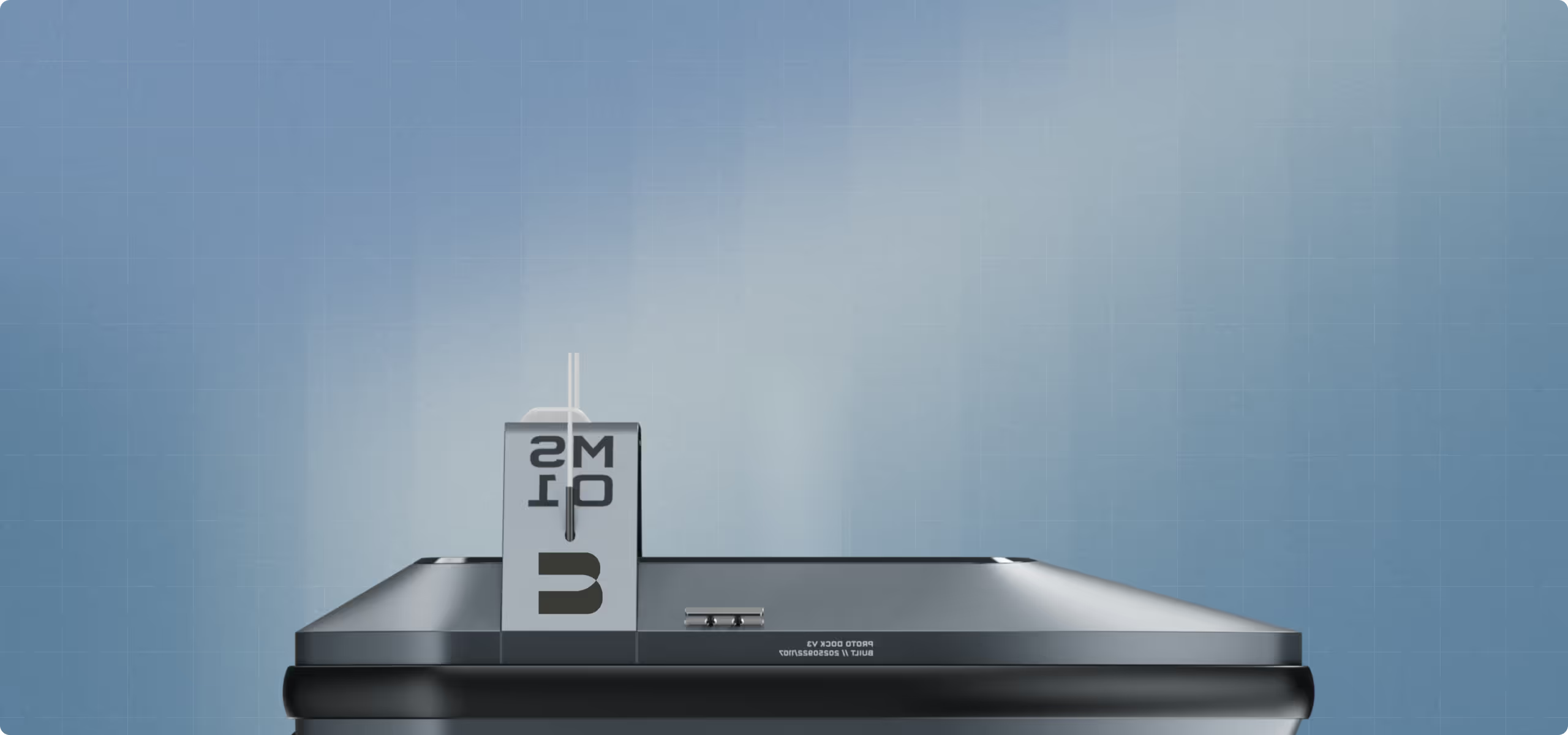
- Docking: There is no standard for docking or charging. Persistence at scale depends on a universal and robust way to let robots live at sea
- Ocean data: The seabed remains one of the least mapped places on Earth. Governments and companies are searching for new ways to fill the gaps
- DVLs: Doppler Velocity Logs are the backbone of underwater navigation. At about $50k with long waitlists, they remain a choke point in the bill of materials.
- 3D perception: Sonar alone is not enough. High resolution subsea LiDAR exists but is out of reach for most operators
- Batteries: Pressure tolerant, long endurance packs are dominated by a few suppliers and remain costly. Cell supply is often concentrated in China
- Manipulation: Most UUVs are still eyes only. Without reliable manipulation, autonomy stops at inspection
Among these chokepoints, docking stands apart. Without a reliable and universal way to recharge and communicate at sea, persistence cannot scale and the cost per km² of ocean monitored stays on a linear curve. The others matter, from cheaper batteries to better navigation and richer perception to manipulation. Docking is the keystone. It turns fleets from temporary expeditions into permanent infrastructure. It is the lever that lets us scale ocean operations the way reusable rockets unlocked a new space race.
7. Why Bubble exists, our purpose
We believe the ocean is the next technological frontier. The convergence of autonomy, connectivity, AI, and new tools has opened a once in a generation window, particularly at a time where the answers to the 21st century’s biggest challenges lie beneath the ocean.
Bubble exists to:
- Make subsea autonomy affordable, persistent, and scalable
- Standardize residency with robust docking and charging
- Turn cheap hardware into smart AI-powered infrastructure integrated in customer workflows.
- Unlock a volume driven ecosystem that accelerates discovery, safety, and prosperity at sea
Our goal: define the new standard for how the ocean is explored and operated.